Lorenzo Arteaga
Game Designer
BORN TO RISE
Game & Level Designer
Studio:
Racoons Making Games
Duration:
1 year
Role:
Game Designer
Tools:
Unreal Engine 4.27
Perforce
Trello
Photoshop
Miro
Team Size:
16
Overview:
Using Unreal Engine 4.27 me and my team created a 2.5D Platformer taking place in a vast underground dungeon. Jump, Dash and shoot to survive and reach the surface.
I Designed and implemented the player character's 3Cs, various game systems, and interactive elements for traditional 2.5D action-platformers. Collaborated closely with our Lead Designer to ensure alignment with the product's high-level vision and goals. Took ownership of my work providing documentation, through iterative processes, effective communication, and collaboration with cross-disciplinary teams, achieving a balance between functionality, visual appeal, and engaging gameplay experiences.
My Role & Ownerships
-
Implemented all movement abilities, aiming and shooting mechanics, and overall camera logic.
-
Game Modes - framework, rule sets, objectives, balance/tuning.
-
Player feedback - VFX, SFX, UI/UX.
-
Designing, scripting, and iterating player mechanics, game mode rules, and event systems.
-
Create overall combat standards for player character and enemies.
-
Designed Enemy AI, including attack patterns and movement behaviors.
-
First dungeon Level Design.
-
Balance all player and enemy abilities by tweaking damage, life values and hit stuns.
Born To Rise is an action platformer that focuses on intense platforming and thrilling combat. It strives to transmit player’s the feeling of increasing power and progression through their own ability to exploit an initial set of mechanics given since the start of the game rather than unlocking new powers as the game progresses. We aimed for the player character to feel agile and powerful, equipped with enough resources to overcome any threat from the beginning. This design choice supports the narrative idea of Yridis (the protagonist) being the apex of her master's creations, ensuring that she alone possesses the capability to escape his vast underground maze.
Character
I was responsible for designing Yridis's 3Cs. To begin with, I wanted her character to be agile and graceful while also maintaining this trope in our narrative, where she is a versatile killing machine capable of surpassing any outcome that the giant hazardous maze she is trapped in dares to present to her. For that we designed a kit for Yridis that reinforces a "back and forth" combat with two ways of confronting enemies: a range attack and a melee attack. We want players to be switching back and forth with a hybrid aggresive style, therefore, many factors must be consider tu ensure both attacks are balanced and feel impactful to the gameplay.
Ranged Attack
Let's start with the ranged attack. Yridis can shoot a long-distance spread of bullets from her position towards its aiming reticle in a 360° angle dealing medium-low damage.
One of the essential factors behind well-designed ranged combat is user experience. Usually in platformers ranged attacks are delimited to what's in front or up from the player character in terms of input, however in our game we wanted to emphasize a more dynamic approach with a 360° range for aiming, like the recent Metroid title; Metroid Dread we tried to mix movement and aiming making the hand of the model our aiming offset and interpolating it so its always facing the player's movement input.
We faced different problems related to this decision afters various testers gave us feedback on the game, some were mislead by the idea of aiming and moving at the same time while others found it difficult to shoot due to the lack of information on the screen.
Due to production constraints, we couldn't put additional pressure on the art department with animation-related changes. Therefore, my design process to find a solution shifted directly to iterating on different input combinations. The goal was to align with players standard input mental maps for platformers without compromising our design intentions. This process led to the final decision of implementing a twin-stick input mapping with a UI reticle visible in the video below. This solution addressed both issues, as players now felt more comfortable moving and shooting, allowing them to deliberately choose their targets.
In terms of balance, we aimed for both melee and ranged options to have a significant impact on gameplay.
Initially, this wasn't the case, as our ranged attack consisted of a "rifle-like" rapid succession of bullets, allowing Yridis to easily eliminate targets from a distance without them posing any threat. My main objective was to penalize long-distance combat without removing it as a valid option, while encouraging players to engage in short to mid-range combat, this, to keep in mind less skilled players so that they can always find their playstyle as something viable within the combat system while encouraging better players to engage with the fun mechanics of the kit.
To address these balance issues, I proposed various solutions:
-
Bullet dispersion: Bullets will deviate from the point of aim when fired, the purpose of this dispersion is to add an element of balance and challenge through:
-
Skill factor: A bullet dispersion will require players to factor in the possibility of missing shots when attacking at long distances.
-
Range Limitations: Bullet dispersion increases at longer ranges, making it more difficult to accurately hit targets at distance. This encourages players to get close and factor in the possibility of hitting with a melee attack due to shortened distances with enemies.
-
-
Finite Ammo: To have delimited ammo not only balances this attack but adds layers of depth to the combat in several ways:
-
Resource Management: Finite ammo adds a new factor for player's to take in since they now have pay attention to this resource in order to shoot.
-
Skillful Play: With finite ammo, accurate and efficient shooting becomes more critical. This feeds the previous solution and encourages players to play more in mid-short ranges since bullets will more likely hit more.
-
Decision-Making: The presence of finite ammo encourages players to decide when or how to engage enemies, when to conseve ammo and when to retreat depending on their play-style.
-
-
Reload: Players can passively reload when releasing and not pressing the fire button, this will slowly reload their ammo until reaching its maximum capacity. Also, players can hit enemies with their melee attack to recharge a % of their maximum capacity.
Since we wanted players to engage with both types of attack all of these three additions aims to keep players bouncing between melee and ranged aggro while keeping the ranged passiveness a valid option for less skilled players.
Melee Attack
Melee attack it's a short range 360° pirouette that deals medium damage and knockbacks enemies away from the player once every few seconds.
The intent with this attack was to emphasize the power of fantasy ideal behind Yridis's character while giving the player tools to keep enemies at bay in short ranges.
As this is a risky mechanic to use, since it forces players to close distances with enemies, we reward them with a powerful attack that deals medium to large damage depending if the enemy was knockbacked.
The knock back relays on a cooldown shown in the form of a breaking shield on top of the enemy's head.
It also adds a layer of depth to the combat system by being a source of ammo, this by refilling part of the player's finite ammo each time it knockbacks an enemy.
By limiting how many times players can recharge their bullets with this attack we emphasize our "back and forth" design, encouraging players to use their cooldowns in the most efficient way.
Damage values were very important to determine enemy difficulty and Yridis's overall balance, for that I provided my team with an excel sheet that clarified each enemy's hit points and damage, along with other specifications. After various testing sessions we ended up with these numbers.

Movement Mechanics
Yridis isn't only made for combat, as a platformer the character's movement plays a huge rol too, she is meant to be a superior being, both agile and gracious. For that she is equipped with all sort of movement mechanics that can be used to scape from the underground maze, we aimed for her to be able to overcome any obstacle related to movement and be as fluid as possible to match with her aesthetics. Her traversal mechanics are the following:
-
Jump
-
Double-Jump
-
Wall-Climb
-
Ledge-Climb
-
Ledge-Slide
-
Dash
We use contact damage for enemies to elevate challenge and encourage decision-making regarding the player's spacing. To complement this design, we make use of the Dash mechanic,to provide players with invincibility frames during its execution. This not only reinforces the dynamic nature of our combat system but also opens a strategic window for evasive maneuvers.
Controller
The player controller must be tight and responsive to support Yridis's design intentions, for that I aimed to use techniques that many games of the genre like Celeste, Hollow Knight, Metroid Dread... have defined for a responsive character controller. This include:
-
Short Hop: When the player releases the jump input quickly, the character performs a shorter jump. This allows for more precise control over jump height and improves landing.
-
Jump Buffer: The player's jump input get registered slightly before the character lands on the ground. This helps to ensure that the character jumps immediately upon landing, making it more responsive.
-
Coyote Time: Whenever a player falls off a ledge they get a brief window of time to execute a jump or other action even after they have technically left a plarform or solid ground. This helps to ensure the controls feels more forgiving and responsive, reducing frustration when meaneuvering on air.
-
Instant Acceleration/Deceleration: The player character gets instantly to its maximum walk speed and stops immediately when the input is released.
-
Full Air Control: The player character can instantly change directions mid air.
For the Input Mapping, after few iterations we ended up with these schemes for both controller and keyboard:


Our main issue came freom the controller schemes, as keyboard players found it very intuitive to have combat-related mechanics attached to the mouse while movement belonged to the keyboard. Conversely, controller players struggled with our twin-stick setup, finding it challenging to aim and jump simultaneously, often resorting to pressing buttons without a clear purpose.
My goal was to ensure that both types of players could make decisions purposefully.
To address this issue, I applied a control scheme philosophy that divided both traversal and combat mechanics on each side of the controller, providing players with the freedom to choose how they wanted playe. The left side of the controller became dedicated to all movement mechanics, while the right side handled all combat mechanics. Face buttons were reserved for the standard platformer input map.
This adjustment resulted in a more intuitive and personalized experience for players, leading to a higher percentage of them playing in a more purposeful manner.
Camera
My main goal with the camera system was to provide players an immersive experience thourghout the game while enhancing gameplay and maintain visual clarity. We achieved our camera goals by following genre standards and introducing the following:
-
Dynamic Framing: The camera dynamically adjusts to focus on the player character and the reticle forward direction. This ensures that players can see crucial details such as enemies and obstacles, always prioritizing their aiming direction to enhance navigation.
-
Smooth transition/Level limits: To control the player's view of the level, we established camera bounds within the level. These bounds precisely delineate the vertical and horizontal limits of the level, enabling the camera to smoothly transition between focusing on the player character and halting its movement to avoid disrupting the game's immersion. Additionally, we implemented restrictions on the camera's vertical axis tracking, limiting it to follow the player only within a specified range defined by these bounds.
Game Mode - Content
Players are placed into a large dungeon to fight and escape from the creatures born off the hands of Yridis's master. The player has two ways of fighting; ranged with projectiles and melee with its own fists. The player is set in a series of thematic rooms filled with hazards, pickups and enemies alike that will challenge the player’s abilities to surpass it. The player must overcome any of these room’s challenges until reaching the end of the dungeon in order to win.
The dungeon is divided in three chambers, each representing the playable levels. Every level is made of rooms with different challenges, the player must overcome these challenges to get to the next room until reaching the end of the chamber, each chamber will have a final challenge in the form of a speed-run section that will break with the player's conventions and challenge everything he has learned during the level.
I used Flow Charts to keep me and my team on track and ensure that the player´s actions and our intentions with the gameplay were on the same spot.

Tools used for development
Me and my design peers used a Miro board to make all our ideas more visible and accessible along with a trello board to keep the design production updated for the team and Google Drive to share documentation and specs.

Miro board.

Trello screenshot
Enemies Design Document.
I was tasked with building the first level of the game. My first step with designing the map was identifying my goals for it, which helped me to measure the viability of my early concepts, and would be crucial to helping me make decisions along the level´s development.
My team and I firstly designed a set of rules with a very basic layout to determine the pacing of the level and which elements were going to appear so that we could visually determine what to tackle in the future for a more balanced environment.


The design goals for this level were to create a layout suitable for both newly experienced players and those already familiar with the genre. The space needed to adhere to an ascending structure to enhance the narrative.
This meant the player needed to always:
-
Have small objectives to rather reinforce or teach him new mechanics.
-
End up in a higher position on each room.
-
Have enough space to safely explore the game.
-
Variety of encounter ranged.
-
Intuitive pathways.
-
Visually distinct areas.
After some iterations this is what the level layout ended up looking.

Results
The first blockout of the map was primarily about getting a playable version of the level so that others could provide their informed feedback.
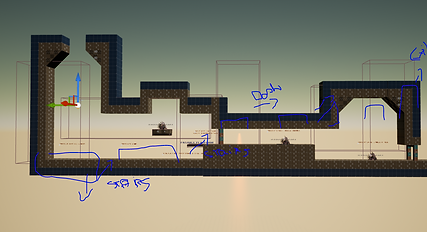
The most evident problem with this version is its small size, lack of spaciality and safe spaces for exploration. Yridis' character movement and higher-than-average time to kill made taking advantage of the limited encounters far too easy of a task to even learn what enemies or hazards even do . There was also the final challenge of the chamber which felt quite off for the majority of testers, it was difficult to navigate and the path to follow wasn´t very intuitive.

BEFORE
In order to achieve a solution for this arising problems, I decided to expand the initial tutorial area of the map into a more open one and tweaked the last challenge room and the 4th room to be more readable and intuitive.


FINAL CHALLENGE
4TH ROOM
TUTORIAL SECTION
This ended with better results for the testers. We proposed them to rank each level of the game with a difficulty number in order to have more clear information on how these changes were affecting the progress of the level. Below there is a graph that shows how different players found the navigation and pacing of the levels during their playtime. My goal was to keep it around 1 and 3 in terms of measurement.
Yellow Color stands for my intended goal difficulty in each room while Blue and Red represented the less experienced and better skilled players respectively.


As seen in the graph the overal difficulty spike was Normal and only during the final challenge in the last room of the chamber, which was an intentional augment in difficulty to prepare players for the next chambers. Less experienced players found easy most of the level while experienced ones felt like it was very easy, since our target is to please casual players and help them engage with the game as much as possible I felt satisfied with the results.